Webinar Report: Industrial Revolution 4.0 & Future of Central Banking (2021)
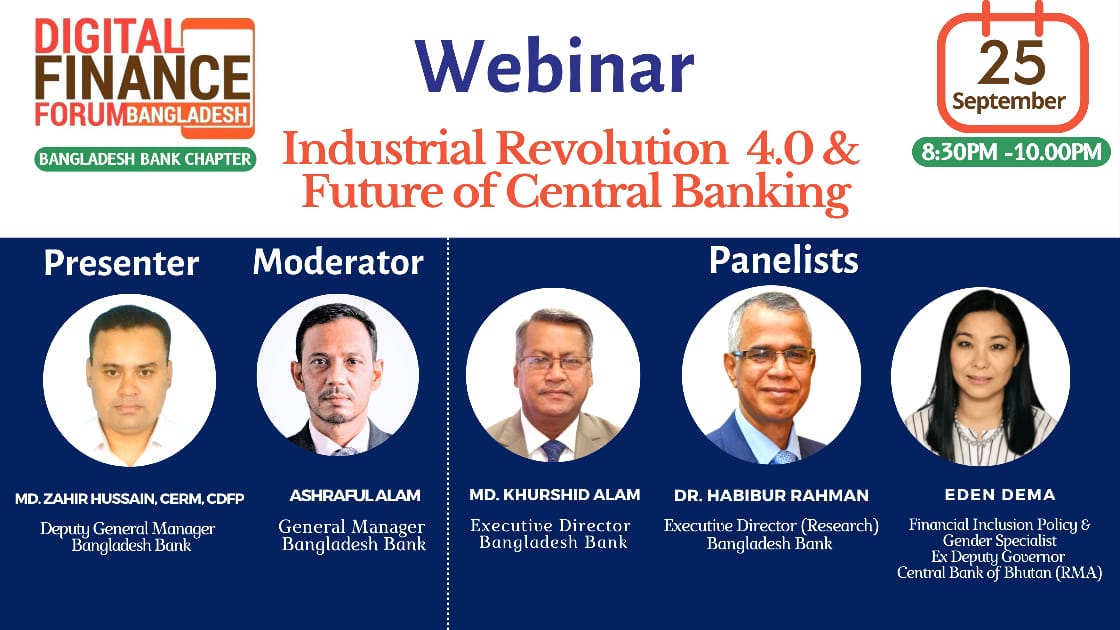
A webinar session titled ‘Industrial Revolution 4.0 & Future of Central Banking’ was organized by Digital Finance Forum Bangladesh- Bangladesh Bank Chapter on 25th September 2021.
At first, Ashraful Alam, the moderator of the webinar gave a short introduction and introduced the keynote speaker, Md. Zahir Hussain and the three panelists- Md. Khurshid Akam, Dr. Habibur Rahman and Eden Dema.
Then, the moderator invited the keynote speaker, Md. Zahir Hussain to continue the webinar. At first, Mr. Zahir talked about the 4 industrial revolutions. The first industrial revolution focused on mechanization, steam, and water power. The second industrial revolution focused on the benefits of mass production and electricity. The third industrial revolution relied on automation and electronic and IT systems. Now, we are moving into the fourth industrial revolution. The 4th industrial revolution facilitates well co-ordination between physical assets and advanced digital technologies like the Internet of Things (IoT), Artificial Intelligence (AI), robots, cloud computing, etc. for communication, review, implementation, and final production.
Industrial Revolution 4.0 facilitates building products and services in a digital process. There are 6 design principles of IR 4.0. They are- interoperability, virtualization, decentralization, real-time capability, service orientation, and modularity. Industrial 4.0 impacts all aspects of a business process, for example, manufacturing, human resources, engineering and supply chain. The digital transformation helps information flow freely and creates disruptions in many industries. The IR 4.0 creates a semantic economy where all business processes can be done digitally. The impact of digital technology on the world’s economy will be between and $14 and $33 trillion a year by 2025. Labor disruptions will be one of the biggest impacts of IR 4.0.
To prepare for IR 4.0, the power supply needs to be abundant, cheap, and continuous, internet band-width needs to be large and have wide coverage, data centers have to be secure, affordable and have large storage, there should be modern logistic infrastructure and finally, the policies should focus primarily on human resources and employment.
The IR 4.0 will increase growth productivity and create new jobs. It will also change the nature of work and high-skilled workers will have more demand. Businesses will have to deal with changing customer expectations. They will have to create new operating models, focus on collaborative innovation, and create data-enhanced products. The government will have to focus on monetary and fiscal adjustments. There may be increased inequality in society. Data security and ethical factors will be a big issue in IR 4.0. People will need cognitive abilities, content skills, process skills, cross-functional skills, etc. to get jobs in the IR 4.0 era.
Bangladesh is taking steps to make itself prepared for IR 4.0. Bangladesh has been focusing on digital transformation since 2008. IR 4.0 makes financial transactions faster and cheaper, reduces operational cost, reduces risk factors, improves business intelligence and helps to make effective use of available assets and money. But, one of the major threats is cyber security.
IR 4.0 also has impacts on monetary policy and financial stability. Central Bank is focusing on digital currency and blockchain technologies for the future. We don’t have digital currency yet. We need to work on that. The central bank isn’t concerned very much about blockchain now. It is a future issue. The central bank is also very much concerned about cybersecurity and new technologies. The critical success factors for central banks are- continuous and open dialogue with all stakeholders, consistent and effective change management, and having an agile mindset.
Then, the moderator invited Eden Dama to continue the webinar and asked her the following question- What are the opportunities of IR 4.0 for developing countries, and what kind of transformations can happen in the banking sector due to IR 4.0? IR 4.0 will bring increased productivity, improve the decision-making process, improve organizational structure, and help facilitate gender equality. Overall, the economy will be balanced and inclusive. But developing countries will have many challenges. The primary challenges that Bangladesh will face in adopting IR 4.0 are- poor infrastructure, availability of cheap labor, high cost of technologies, lack of human resources, etc.
Although MSMEs play a large role in the economy, they face difficulties getting access to finance. 67.3% of the formal MSMEs in Bangladesh still lack access to financing. IR 4.0 can help MSMEs in multiple ways, for example, giving them access to finance, markets, bundles of financial services, and providing bookkeeping services
Then, the moderator invited Md. Khurshid Akam and asked him – Will IR 4.0 cut jobs and will it affect Central Banks' goal of creating more jobs? Mr. Khurshid thinks that IR 4.0 has a narrow possibility to cut jobs because digital technologies also create new jobs. For example, Food Panda has given job opportunities to many young people who lost their jobs due to the pandemic. But a lot of jobs will be replaced. So, people will have to reskill and adjust to the changing technological environment.
Then, the moderator invited Dr. Habibur Rahman and asked him how the Central bank should formulate monetary policy for IR 4.0 and whether new technologies pose severe threats to the financial stability of Bangladesh. Dr. Habibur said that because of the cost reduction effects of IR 4.0, the economy might see reduced inflation or price cuts over the years. The main purpose of monetary policy is to control inflation and support the productive pursuit of the government. If there is no inflation, countries will go for unconventional monetary policy. For the greater good of the nation, Bangladesh Bank wants to support employment and investment, output growth while controlling the inflation in check. For digital currencies, it will require new policies and new regulations from Bangladesh Bank, so it is a challenge for Bangladesh Bank.
The moderator again asked Dr. Habibur Rahman a second question- What will be the Bangladesh Bank’s strategy in the short, mid, and long term to cope with the challenges posed by industrial revolution 4.0?
Dr. Habibur Rahman thinks that Bangladesh Bank is approaching in the right direction. The economy of Bangladesh is not open. Our current account is open but the capital account is restricted. The capital account is a kind of one-way opening. Things can come in, particularly the foreign currency, but taking foreign exchange outside the country is difficult. It helps us to tackle crises. For example, we could tackle the financial crisis of 2008 due to our capital market restriction. We are gradually liberalizing our foreign exchange and we are also liberalizing our payment system. By doing this, we are coping with IR 4.0.
The moderator asked Md. Khurshid Aam a second question - How should central banks cope up with the IR 4.0? He said that Bangladesh Bank is taking the right steps to cope with IR 4.0. The government should first focus on huge investment in research and development. Secondly, the government should take steps to educate the young generation about digital transformation. Thirdly, we need huge capital investment. Fourthly, Bangladesh Bank should make finance easily available. Fifthly, the central bank should create regulations to minimize risks related to digital finance services including e-commerce. Finally, we should have the willingness to adopt new technologies.
The moderator asked Eden Dema a second question – Can this digital innovation reduce income inequality in developing economies? She agrees with this statement and said that we can do that by addressing the inequality gaps. Since 2011, the percentage of adults with a bank account has increased by 18% and has reached 69% in 2017. But more than a billion people are still unbanked. Most of the people in the BOP (Bottom of the Pyramid) and MSMEs don’t have easy access to financial services. First, we need to understand the persistent barriers to financial inclusion, for example, physical infrastructure, financial infrastructure, digital infrastructure, policy, and regulatory bottlenecks. To support digital transformation, we need to create strong infrastructure especially communication networks and strong power supply. We have to establish a robust credit information bureau and should allow movable collateral registries to support MSMEs and unbanked people. We also need to provide youth empowerment funds, create specialized banks for women, MSMEs, and special groups. We will also have to build a robust digital infrastructure of payment and e-commerce. Partnerships between different financial service providers are also important. These steps will improve the financial power of MSMEs and reduce income inequality. With this, the panel discussion segment of the webinar ended.
Then, the moderator invited Arijit Chowdhury to comment on the webinar. He said that he is very interested to know what will be the immediate steps that will be taken by Bangladesh Bank to fully implement the different aspects of the Financial Inclusion Strategy of the government. Md. Khurshid Alam said that for the implementation of the national strategy for financial inclusion, Bangladesh Bank has set up a separate directorate headed by the Executive Director.
Question Answer Session:
There was a question asked by one of the participants about whether unskilled labor will be left out because of IR 4.0 and what strategy should Bangladesh Bank take to employ this unskilled labor force? Khurshid Alam answered that we have to educate our people. So, reskill policies should be taken.
The moderator finished the webinar by thanking the participants and asked Digital Finance Forum: Bangladesh Bank Chapter to regularly organize webinars to help central bankers.
|