How to build e-NID with existing IDs in Bangladesh
Bangladesh has recently celebrated its golden jubilee of independence and received final nod by UN for graduation from the Least Developed Countries (LDCs). The country is going through a rapid digital transformation to make the country a developed nation by 2041, a political commitment of the current government. We are now dreaming of building digital Bangladesh as a cashless (or cash-lite) society. The government has taken several initiatives to bring all government services in digital platforms. But, it is not possible with the existing fragmented identity infrastructure where complete authentication of the service recipients is not possible remotely. Therefore, an integrated digital identity infrastructure as well as an appropriate organizational set up is necessary for the overall development of the country to fulfill the dream of Digital Bangladesh.
Government of Bangladesh (GoB) already adopted the ‘Perspective Plan of Bangladesh 2021-2041' emphasized collaboration and innovation for redesigning institutions and norms to respond effectively to the fast face of digital transformation. The GoB formulated the ‘8th Five Year Plan' and has taken an action agenda for launching of Universal Identity System (UIS) with profiling for multi-purpose use and proposed an Inter-agency working group for appropriate design and roadmap for UIS, enactment of data Interoperability Law and enactment of data protection and privacy Law [e.g., GDPR] by 2022.
Why we need e-ID
Identity is a fundamental prerequisite for individuals to avail most of the government services, different types of private services including financial or non-financial services and participate in social and political systems. We use different types of credentials, such as passports, ID cards, driving license and birth certificates, etc. to prove who we are.
As we move towards the Fourth Industrial Revolution, our interactions and transactions are growing beyond geographical boundaries. Already a strong network of cross-border payments has been developed and a digital representation of our identity has become increasingly important as transactions are conducted digitally. Different types of identity information are collected during issuance of foundational identity i.e. National Identity card and birth registration as well as functional identity i.e. passport, driving license, KYC of financial services and mobile SIM. As a result of disintegrated databases, verification and authentication of citizens are required for every instance separately. Moreover, all information cannot by verified by each institution due to different limitations. These eventually increase cost and risk for service providers and customers as well as inefficiency in service delivery. Digital identity is the only way to connect different types of identity information through in interoperable platform.
The Election Commission of Bangladesh prepares electoral rolls for adult franchise under Section 119(1)(d) of the Constitution and a paper based voter ID card was provided during 2008-2009.It was renamed to National Identity Number (NID) through Section 2(3) of National Identity Registration Act, 2010.Then the paper based NID has been gradually replaced by biometric and microchip embedded Smart ID cards since 2016.It is a machine-readable pocket-sized plastic card and integrated circuits store the data and prevent forgery. But, limited Personal Identifiable Information (PII) and lack of remote/digital authentication as well as authorization services are the main shortcomings of the existing NID/smart card which prevents to term it as a Digital ID. Compared to paper-based identity card, digital identity has the potential to increase the accuracy and reliability of identity data and credentials, automated the processes for saving money, increasing convenience and providing new platforms for innovation in service delivery.
Should we stay behind?
If we want to turn NID into an international standard digital ID, we need to combine different technologies and include more personal identifiable information and biometric information (e.g. ten fingerprints, iris scan, facial recognition, etc.). Many other countries have already incorporated many features on their digital national identity cards considering these issues.
India’s Aadhaar
Aadhaar of India is the largest identity database in the world. In 2009, India had established Unique Identity Authority of India (UIDAI)and initiated enrolment of all Indian residents. Individuals cannot use this Aadhaar number to claim citizenship but it is used for many other purposes, both public and private sector. Within just one decade, the enrolment reached over 90% of the population. Total 1257.9 million Aadhaar have been generated, 7973.8 million e-KYC authentications conducted, 688.7 million Aadhaar number linked to 110 crore bank accounts till 31 March, 2020. The return on investment (ROI) was estimated 52% in 2012 for the period 2012-2020. Ministry of Finance claimed in 2017 that $5.6 billion savings over two years due to leakage in benefits schemes. It has also been estimated that banks and telecom companies could save $1.6 billion from e-KYC over five years. India is currently building additional layers over Aadhaar under India Stack: Aadhaar eID, Universal Payment Interface, Digital locker and consent based data interoperability.
Estonia’s e-Estonia
e-Estonia is the first ‘true digital ID’ and compulsory for Estonian citizen and about 99% citizen have been enrolled. It is used for verities of purposes, such as travel, voting, access to government as well as private services, digitally signing contracts, etc. About 99% state services are available online through government’s middleware (X-road); 70% citizens use the ID card regularly; 43.8% Estonian cast their vote online in Parliament election 2019 and 2600+ services can be accessed through the eID. e-Estonia ID is also available in the form of smart card (smart-ID), mobile-ID and online version (DigiID).
UK’s GOV.UK Verify
The UK government has established GOV.UK Verify, a federated ID scheme where it works as a central hub among private ID providers (IDPs) and it does not provide any ID itself. The central platform manages interaction between users, IDPs, government services for the purpose of authenticating users to access government services.
BankID in Sweden
Swedish government allowed private organizations to offer digital ID services and the scattered public ID system encouraged some leading private banks to introduce BankID back in 2003. It is owned and managed by bank owned utility company and there are currently 80 million (i.e. 80% of citizens) active users of BankID which is used to access services of both public and private organizations including identification, conduct transactions and signing documents. The BankID company receives fee for usage of the services.
ID infrastructure in Bangladesh
Bangladesh has several foundational and functional identity systems. As per ‘Birth and Death Registration Act, 2004’, birth registration is mandatory within 45 days of birth for all new born in Bangladesh. Local government authorities and Bangladesh Mission abroad are authorized to issue birth certificate. Total 178.87 million births registered through Online Birth Registration System (BRIS) since 2010.
National Identity (NID) card issued to age 18 and above citizens by Election Commission has been initially developed for voting purpose. However, it is widely used in other purposes, such as banking, asset registration, mobile SIM, passport, driving license, etc. Passport is issued by Department of Immigration and Passport (DIP) mainly for foreign travel. Driving license is issued by Bangladesh Road Transport Authority (BRTA) as eligibility of driving. All the four identity cards are issued by government agencies.
About 50% of adult population of Bangladesh had bank account in 2017 and banks follow a robust KYC procedure for AML/CFT compliance. As per Bangladesh Bank statistics, about 112.75 million accounts were operated by banks in 2020. Mobile Financial Services (MFS) are allowed for small ticket transaction and KYC requirements are also minimum. There are 173.36 million mobile subscribers in Bangladesh and mobile SIM are biometrically registered and matched with NID information. All these databases of large population may be used to develop a universal identity system for people of all age, sex, class and geographic locations.
Blueprint for interoperable Digital ID scheme
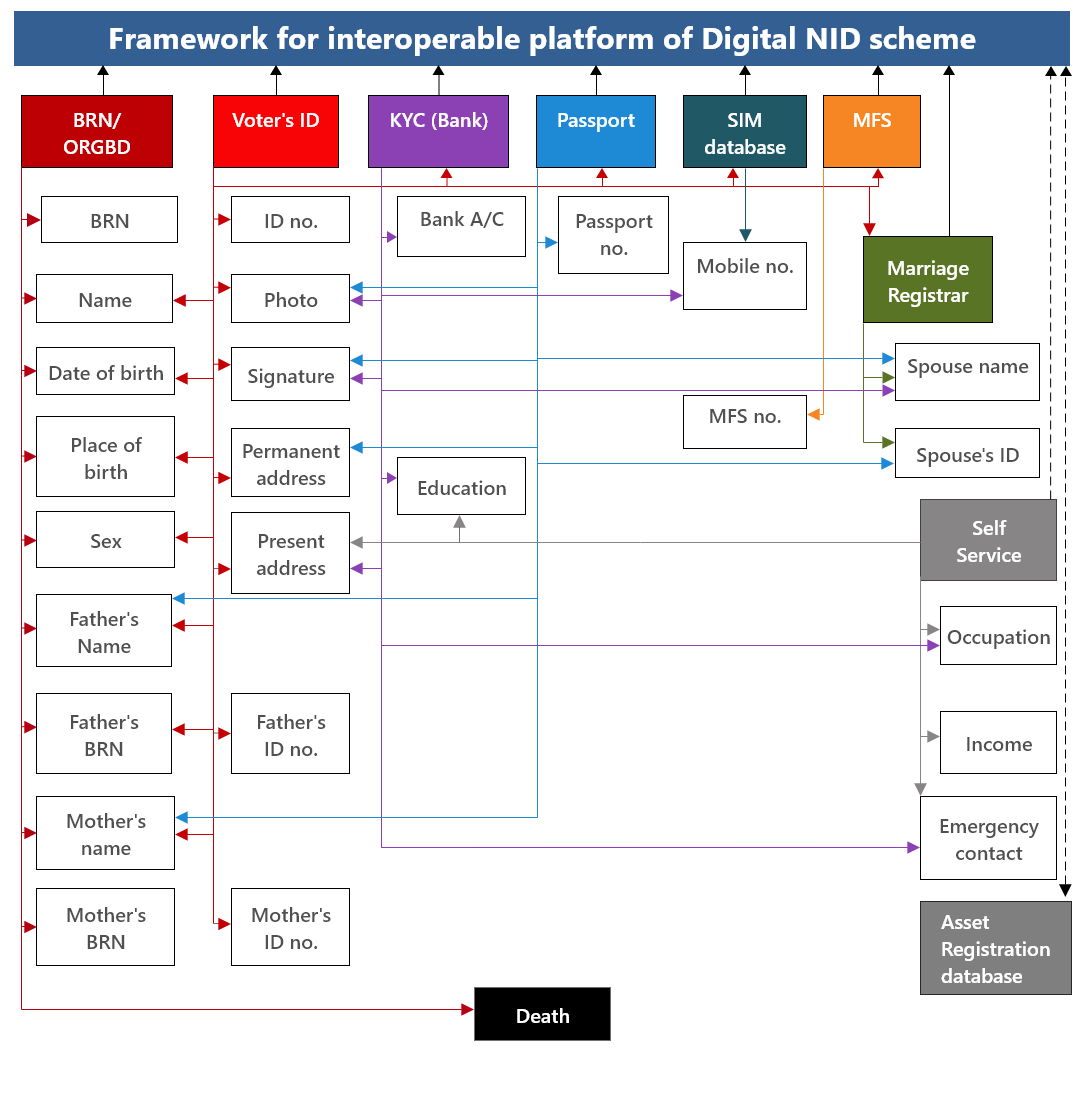
The government has already taken some initiatives to establish digital ID scheme. ICT Division, Government of Bangladesh currently implementing a project, named Integrated Service Delivery Platform (ISDP). The stated objectives of the project include citizen profiling, and integration of identity servers e.g. NID, Passport, BRN and driving license. Citizens’ data will be collected only once in their lifetime and those will be shared across all service providing organizations and information system. Citizens will use single credentials to access services via an identity hub or gateway that facilitates authentication across multiple platforms.
Middleware based architecture will be established to simplify the integration of legacy identity systems within e-government platforms. Advanced and user-friendly features like QR code, fingerprint, password, PIN, OTP based log-in, OCR, Digital Locker, etc. will be available. But, other than technical specifications, the project has not outlined any operational or legal aspects of identity data management or use of such data by private actors.
Establish ‘Bangladesh e-NID Authority’ through an Act of Parliament
The national identity card (NID)is a byproduct of the voter database developed and managed by the Election Commission under Constitutional provision. However, the government has recently decided to shift the responsibility of national identity card (NID) management from the Election Commission to Ministry of Home Affairs following examples of some other countries. But, changing the authority of voters’ database i.e. NID will be a violation of the Constitution. So, it will be rational to retain responsibilities of electoral rolls to The Election Commission for adult franchise and establish a separate institution for electronic and universal national identity card (e-NID).
Identity management is becoming more complex and sensitive in this interconnected digital world. Without proper control, digital ID system administrators could gain access to and control over personal data in evil motive. Administrator could misuse data for economic or non-economic purposes. So, right governance and control should be in place to mitigate potential abuse of digital ID.
So, establishing an e-NID Authority through an Act of the Parliament under Ministry of Home Affairs with legal rights to collect ID information from both public and private organizations, and protect large volume of personal data is the best policy option. Government targeted launching of Universal Identity System (UIS) with profiling for multi-purpose use by 2022 in 8th Five Year Plan and some activities are already in progress under ISDP project. So, the interoperable platform and Bangladesh e-NID Authority may be fully operational by December, 2022 if appropriate measures taken. The proposed e-NID will fulfill the functions of Civil Registry and Vital Statistics (CRVS) project under Cabinet Division, National Population Register proposed by Bangladesh Bureau of Statistics and national security concerns of the Ministry of Home Affairs.
Writers:
Mohammad Rashed, Certified Digital Finance Practitioner & President, Digital Finance Forum Bangladesh
A.S.M. Ahsan Habib, Principal Officer, Uttara Bank Ltd.
Email: digitalfinanceforumbd@gmail.com
N.B.: The article were published in The Financial Express on September 28, 2021 and in The Business Standard on 15 October, 2021.
|